
2026-11-22T08:49:50-07:000000005030202611
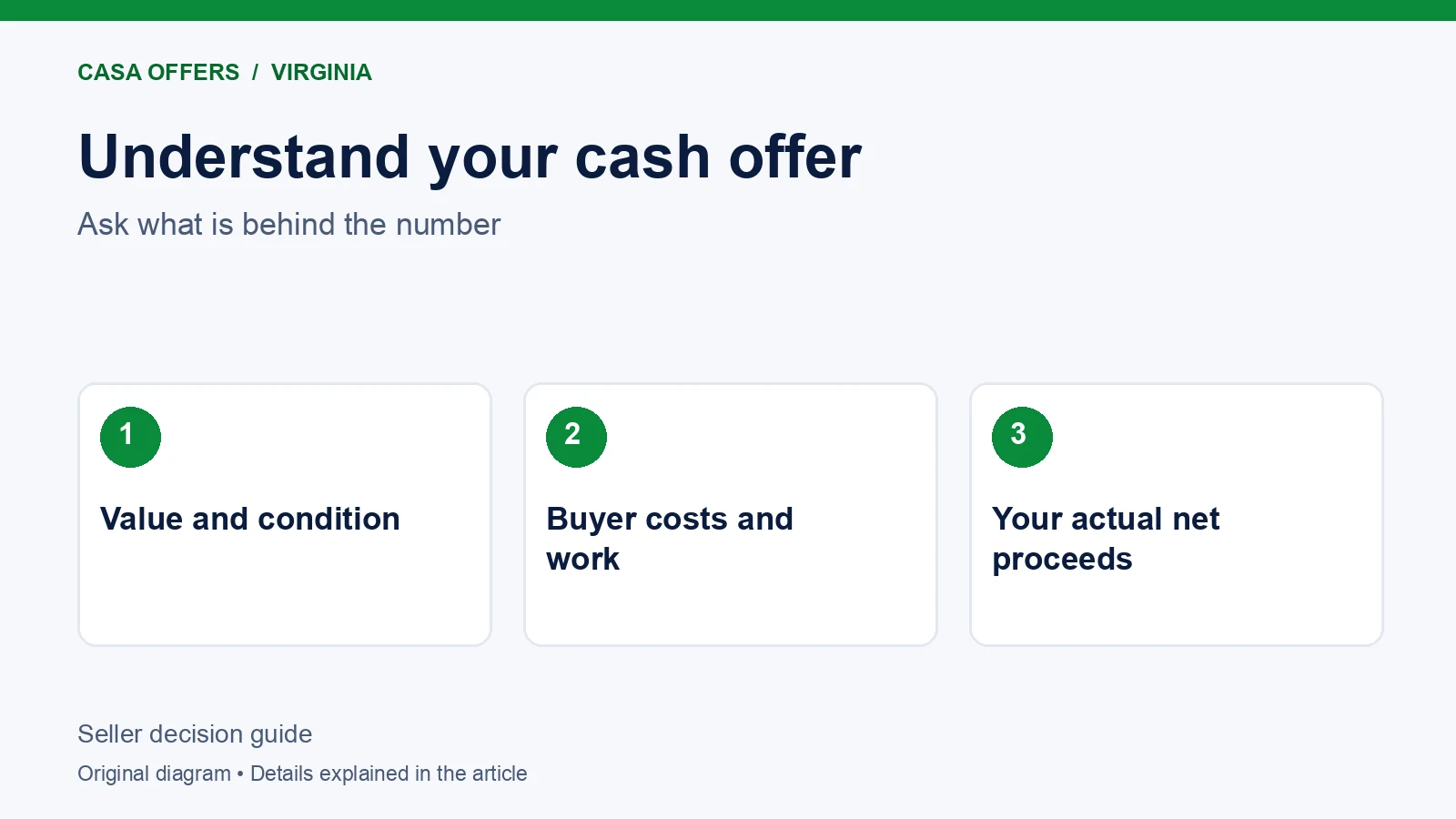
Cash home buyers in Richmond evaluate the property, agree a price and buy with available funds rather than making the purchase dependent on a new traditional mortgage.
Some buy to renovate and resell; others plan to rent or occupy the house. Their business plans affect what they can offer. “Cash” alone does not tell you the net you will receive or the contract conditions.
We recently bought a Richmond house that felt like a time capsule: original 1987 carpet, cabinets and finishes, still intact. The work was extensive anyway. A house does not have to be falling apart for its next sale to involve a new kitchen, flooring and months of coordination.
When cash home buyers offer less than a renovated house nearby, you deserve more than “that’s our number.” What work separates your house from that sale? Who will fund it, manage it and keep paying the bills until it is done? Here is how we walk through the five numbers behind an offer.
Five numbers to understand before comparing cash home buyers
A useful offer conversation separates five things: the property’s supported value, the work needed, the buyer’s ownership costs and return, the selling expenses assigned to you, and the debts already attached to your sale. These are not interchangeable deductions. They answer different questions.
| Number | What it tells you |
|---|---|
| 1. Supported property value | What comparable completed sales actually support for the relevant condition |
| 2. Repair and preparation scope | What the buyer expects to spend or take responsibility for |
| 3. Ownership costs and return | Why a buyer’s business plan differs from a retail purchaser’s budget |
| 4. Your selling expenses | What the written agreement leaves you to pay |
| 5. Your existing obligations | What must be paid from the transaction before calculating your proceeds |
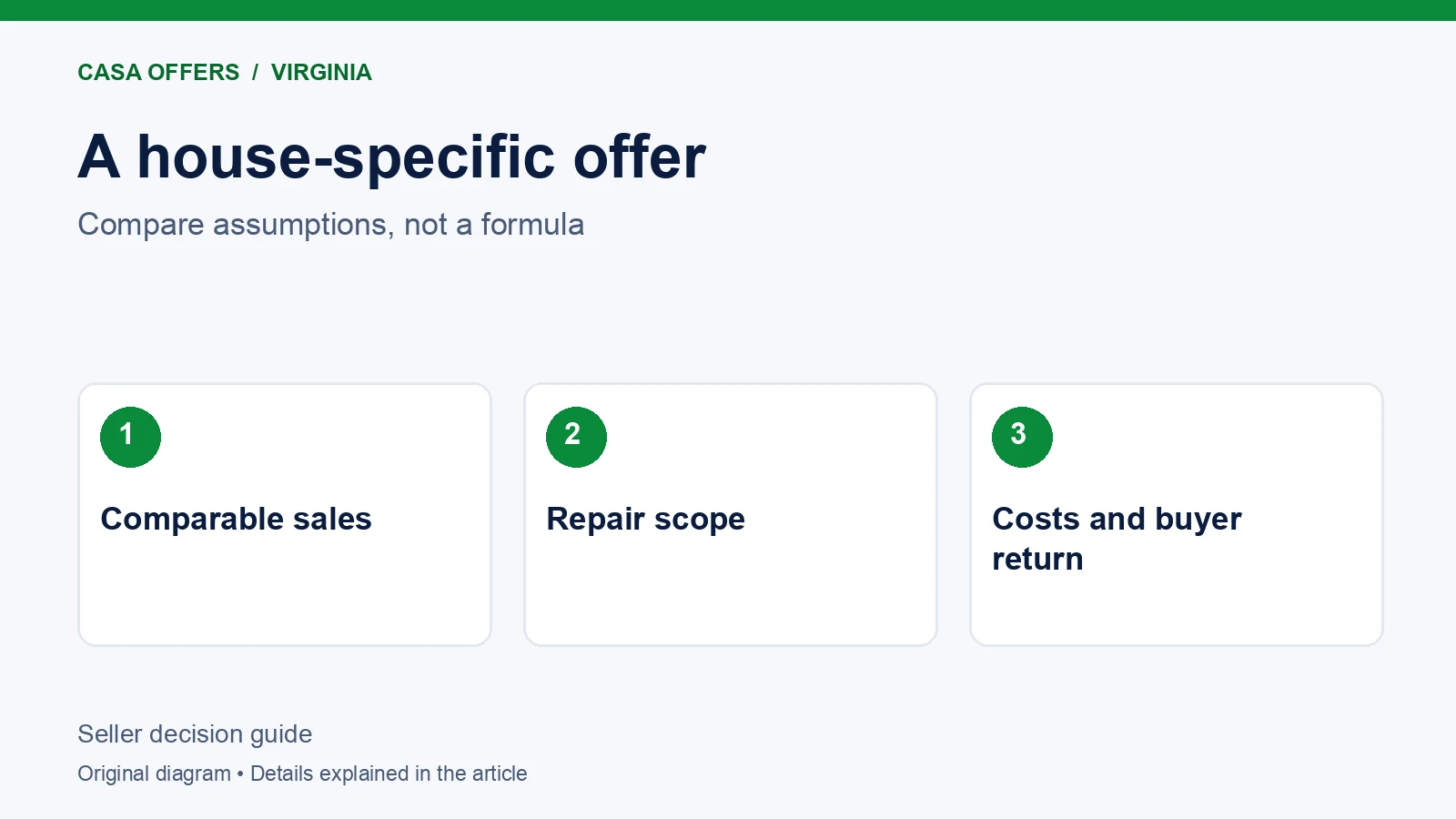
1. Start with comparable sales and the correct condition
If you point to a renovated house nearby and say, “That is what my house is worth,” our answer starts with respect: you may be right about what yours could be worth after the same work. The next question is what it takes to get there.
For example, would reaching that standard mean spending $50,000–$80,000 and the next three to six months hiring and coordinating contractors? Those are illustrative planning ranges, not a quote for your property or the budget of the 1987 house. Put your actual written estimates and likely timeline beside the finished-value estimate before choosing that route.
An investor considering renovation may start with an estimate of the finished property’s value. That estimate needs support in recent, relevant completed sales. A listing’s asking price or an automated estimate starts the conversation; it does not prove what a buyer will pay. Ask which completed sales support the number and how they differ from your house.
In the Richmond area, verify whether the parcel is in Richmond city, Henrico or Chesterfield. The city assessor, Henrico assessment office and Chesterfield assessment office offer property-record resources. Use them to check the file, not to substitute a tax assessment for a condition-specific offer.
Tax assessment is a useful reference, too. Casa can pay close to assessed value or more on some properties; the assessment is not an automatic ceiling or a promised offer. Ask which sales are comparable, whether they were renovated, how usable space differs and what the buyer assumes about the house’s eventual use. Two cash home buyers can reach different prices because their assumptions and plans differ.
2. Make the repair scope visible
“Needs work” is too vague to explain a price. Ask cash home buyers to distinguish cosmetic updating, major systems, water or structural concerns, permit questions, cleanout and uncertainty they have not yet resolved. A kitchen refresh and a failed foundation are different projects.
A Richmond house can be intact and still need extensive updating
In that 1987 house, the renovation scope included new countertops and appliances, removing a wall to open the small kitchen, flooring throughout, and new carpet where we planned to keep carpet. It also included redoing the fireplace, repairing the porch and landscaping.
The flooring was not necessarily bad. It was old. The cabinets and layout belonged to another era. That is the distinction we want a seller to see: the value of a renovated comparable comes with the work needed to create that result. You can take on that project yourself, or compare a sale to a buyer prepared to take it on.
The first contractor number may not be the final number
A repair quote can feel like taking your car to the dealership: you agree to one job, then another issue appears. Extra work, a missing item or a change order can move the budget after you thought the price was settled. Ask what the quote includes, what it excludes and how extra work must be approved.
You also have to choose and coordinate the people doing the job. A contractor who does not finish, or work that has to be redone, can cost you money and delay the sale. Use a written scope, verify the contractor and agree payment and change-order terms before committing funds.
You can bring existing estimates and reports to the discussion. Ask what happens if an assumption turns out to be wrong and when the offer becomes firm. A buyer who has already evaluated the property should be able to explain the important assumptions without handing you a demand to renovate it first.
At Casa, the point of buying in the current condition is to take on work the seller does not want or cannot fund. Our Virginia repair-priority guide can help you decide which preparation costs deserve a second look before you spend.
3. Understand the buyer’s costs and profit without accepting a formula
A renovating buyer may account for financing, taxes, insurance, utilities, project management, resale expenses, market risk and profit in addition to construction. A rental buyer may evaluate rent and operating costs instead. Those business assumptions influence the offer; they are not automatically separate bills charged to you at closing.
Do not assume every Richmond buyer uses the same percentage of a renovated value. A rule of thumb cannot capture a specific house, repair plan, holding period or resale risk. Ask for the reasoning and compare actual written offers rather than negotiating against an internet formula.
Casa is a business and expects to earn a return. The useful test for the seller is whether taking the work, cost and logistics off your shoulders produces a result you prefer to the realistic alternative. An offer does not need to be the highest imaginable resale price to be useful, and convenience does not mean you should stop comparing.
Two months of repairs still means two months of house payments
Suppose the work is quoted at $20,000, takes two months and your mortgage payment is $4,000 a month. That is $28,000 of cash outlay during the project: $20,000 for work plus $8,000 in payments. If the work takes a third month, the cash requirement reaches $32,000 before any repair overrun or other bills.
This is a hypothetical cash-budget example, not the cost of our Richmond purchase. Include any insurance, taxes and other bills not already included in your mortgage payment, plus utilities. When comparing final net proceeds, account for principal paid down in the mortgage payoff; do not count it twice as both an expense and an unchanged debt.
The number that matters is not just the contractor’s quote. It is whether you can fund the whole project and keep the house going until it is ready to sell.
4. Identify what you must pay to sell
Some cash home buyers cover agreed closing expenses; others allocate charges differently. Ask about service fees, title and settlement charges, any existing agent agreement, cleanout, concessions and possession arrangements. An advertisement saying “no commission” does not answer every cost question.
At Casa, we buy directly and cover the agreed selling and closing expenses. The seller still pays what they already owe, such as the mortgage, past-due taxes or other obligations identified through settlement. Put the cost allocation in writing so the purchase price can be turned into a credible net figure.
Compare that figure with an ordinary sale using negotiated compensation and actual estimates, not an assumed universal commission percentage. Include cash you must spend before closing, as well as charges deducted at settlement. A higher price can leave less money if the extra expenses are large enough; it can also leave more. Work through the actual proposal.
5. Subtract existing obligations to estimate your proceeds
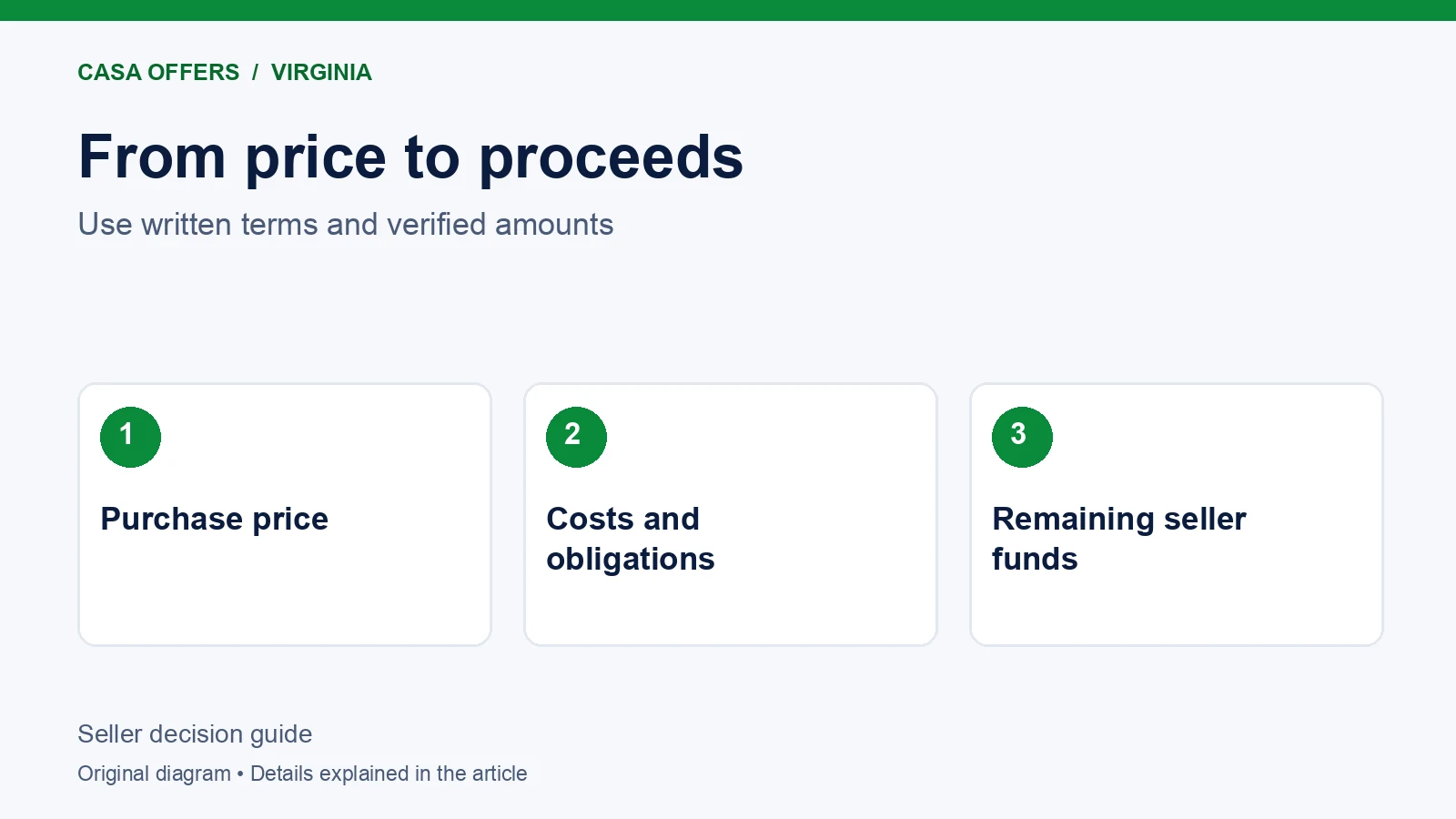
Your Casa home buying specialist walks you through the estimate of what you will receive. Start with the written purchase price, separate the expenses Casa has agreed to cover, and identify the obligations that remain yours. You should be able to see how the offer turns into money available for your next move.
Your mortgage payoff is not a discount the buyer invented. Neither are past-due taxes or a valid lien. The settlement team obtains current payoffs and reconciles the final amounts. Ask your specialist to explain the estimate and the settlement team to explain any difference in the closing figures.
| Item | What to enter |
|---|---|
| Purchase price | The amount in the written offer |
| Less seller-paid selling expenses | Only costs assigned to you, including any agreed credits |
| Less existing obligations | Current mortgage payoff, taxes, liens and other verified amounts |
| Less amounts already advanced | Any documented advance deducted from proceeds |
| Estimated remaining proceeds | Have the settlement team reconcile the calculation |
If you need a moving advance, we start by checking whether you have enough equity. Casa can consider an advance before closing, deducted from your sale proceeds. It is money received earlier, not extra money on top of the purchase price. Confirm the amount, timing and transaction terms with your specialist before making moving commitments.
For two offers in hand, see how to compare the money each offer leaves you.
What happens after you choose an offer?
The buyer and seller document the agreement; the settlement team checks ownership and title, obtains payoffs and coordinates the transfer and funds. Confirm inspection rights, deposit timing, required signatures, possession and who is responsible for each open item. A cash offer does not make a title dispute disappear.
Virginia’s settlement-agent statute addresses recordation and disbursement. Ask the actual settlement team when your funds will be available; signing an appointment is not a promise that money will be usable immediately. For deadline planning, use our Richmond fast-sale guide.
Cash home buyers also differ in who will actually purchase. At Casa, we are the buyer, sometimes working with contractors or partners. For proof of funds, assignment terms and the buyer named in the contract, see our separate seven-check buyer-verification guide.
When does a cash offer make sense?
A house ready for the market, a seller able to prepare it and enough flexibility for the selling process may favor a listing. A direct purchase deserves consideration when you want to avoid funding repairs, managing a cleanout or coordinating repeated access, or when convenience has real value to you.
Bring Casa the condition today and the outcome you want. We can explain the offer, what work we would take on and how the proposed numbers affect you. The conversation and offer carry no obligation. If another route fits better, you should know that before committing.
Get My Written Cash-Offer Review
Questions about cash home buyers in Richmond
Do cash home buyers always pay less than a listing?
The price and the seller’s net are different comparisons. A listing can produce more, particularly for a market-ready house. Compare an actual offer with a supported sale estimate after preparation, selling expenses and existing obligations.
Do cash buyers skip inspections and title work?
Not automatically. Cash describes funding, while the contract controls inspections and conditions. Title and settlement requirements still need to be addressed.
Is there one standard percentage a buyer should offer?
No universal percentage establishes a fair offer for every property. Compare the house-specific assumptions, written costs, contract conditions and your realistic alternatives.
What should I have ready to discuss a cash offer?
Start with the address, current condition, occupants, owners and the date you want to move. Existing estimates or reports can help explain the work. You do not need to invent a renovated value or guess your mortgage payoff. Ask cash home buyers to explain their assumptions and the settlement team to obtain current debt figures. Keep confirmed amounts separate from estimates when comparing proposals.