
2026-10-23T03:48:24-06:000000002431202610

When you search “we buy houses Richmond VA,” you need more than a list of companies.
You need to know which buyer can complete your sale, what could change the price, and how much money you will actually receive. Check the buyer’s identity, funding, contract conditions, net proceeds, deposit, occupancy terms and closing commitments before you sign.
The attractive number gets your attention. The agreement determines whether you can build your next move around it.
I remember walking into an older homeowner’s house during her second summer without air conditioning. There was one fan. The house was painfully hot, belongings had piled up, and she did not have the money to fix the basics.
She wanted to move closer to family. She had tried the traditional selling route, but, as she explained it to me, the house needed substantial work before an agent would take it on. She could not fund that work. Here was someone with equity in her house, trapped in a living situation nobody’s mom should have to endure.
What she needed first was to know another option existed. You should not have to find repair money you do not have just to start a conversation about selling. A direct as-is purchase can be a way to move forward without making the house ready for the next owner yourself.
But you still deserve to understand the offer. A helpful buyer should explain who is purchasing, where the money comes from and what the written agreement means for you. These seven checks help you compare that option with listing—and ask Casa Offers the same questions you ask anyone else.
1. “We buy houses Richmond VA”: who is actually buying?
Start with the name on the purchase agreement. Is it the company whose website you visited, a related purchasing company or someone else? Who is authorized to sign for that business, and who will answer your questions after you sign?
At Casa Offers, we are the buyers. We work with contractors and vendors to get houses ready for their next chapter; our role is to purchase the property, not simply pass your inquiry to someone else. Ask us to identify the purchasing entity on your agreement and explain any partner’s role.
A brand name and a purchasing entity can legitimately differ. Ask the person to explain the relationship clearly. If they cannot explain who is making the commitment, pause before adding your signature.
Then ask whether that buyer intends to purchase the house itself or transfer its contractual rights to another buyer. That transfer is commonly called an assignment. Read what the agreement permits and ask what happens if another buyer is not found. Neither a friendly introduction nor a company label answers those questions.
The Virginia State Corporation Commission’s Clerk’s Information System provides business information. Use it to check the entity you have been given. Registration helps establish identity; it does not prove available funds, experience or a successful closing record.
For reviews, open the actual source profile. Check that its name, website and service area belong to the same business. Look for details about completed sales and how problems were handled. A screenshot of stars gives you less to investigate. If someone presents themselves as a licensed real estate professional, check that claim through Virginia’s DPOR license lookup.
2. Ask how the buyer will fund this purchase
“Cash” tells you something about the proposed transaction. It does not tell you whether this particular buyer has money committed to your house.
Ask for current evidence of funds or financing appropriate to the purchase. The buyer may use its own funds or an investor or lender. What matters is understanding the source, any approval still required and whether the proposed schedule accounts for it.
Check whether the evidence identifies the buyer or explains its relationship to the funding source. Does the amount support the offer? Is it current? Is it a general prequalification, a conditional commitment or available cash? Sensitive account numbers can be redacted without making the rest of the document meaningless.
Have your closing professional help verify material funding questions through independently confirmed contacts. A document alone cannot guarantee performance, but a buyer who can explain the funding path gives you something concrete to assess.
With Casa, you can ask for current proof of funds, including bank evidence or the credit line supporting the purchase. You can also ask how to check completed purchases in local property records. A record of a past purchase and evidence for this purchase answer different questions; use both.
The useful question is simple: “What still has to happen before the money is available for my closing?” Get that answer before scheduling a move around the proposed date.
3. Read what could change the price or end the deal
An offer can sound firm on the phone and remain highly conditional on paper. Ask the buyer to identify every provision that allows further review, a price change, an extension or cancellation.
- Property review: What inspections, walkthroughs or document reviews remain, and when must they finish?
- Financing: Does the purchase depend on a loan, partner approval or another transaction?
- Assignment: Can the buyer transfer the agreement, and who remains responsible?
- Title and other conditions: What must be resolved, who handles it and by what date?
Our Casa walkthrough is primarily for planning the construction ahead. We analyze the property before making an offer; the visit is not intended as a second negotiation over ordinary repairs. A seller’s gross misrepresentation of the property is a different issue. Describe the condition honestly and make sure our written agreement reflects that understanding.
When comparing buyers, distinguish that kind of confirmation visit from a broad inspection contingency. Ask what the contract actually permits. “No repairs” alone does not explain the buyer’s rights to change the price or walk away.
If a buyer changes its offer after seeing the property, ask for the reason, supporting details and revised terms in writing. You can compare those terms with your alternatives instead of treating the first number as money already earned.
For contract interpretation, use your own Virginia real estate attorney. The person buying your house has a different role from the person advising you. Take the time to understand your obligations before signing.
Want a number to put beside the other offers? Start with the house as it sits today and ask what assumptions support the offer.
Request My Richmond Cash Offer
If the previous buyer backed out, check the release and deposit before accepting another offer.
4. Compare cash home buyers in Richmond, VA by what you keep
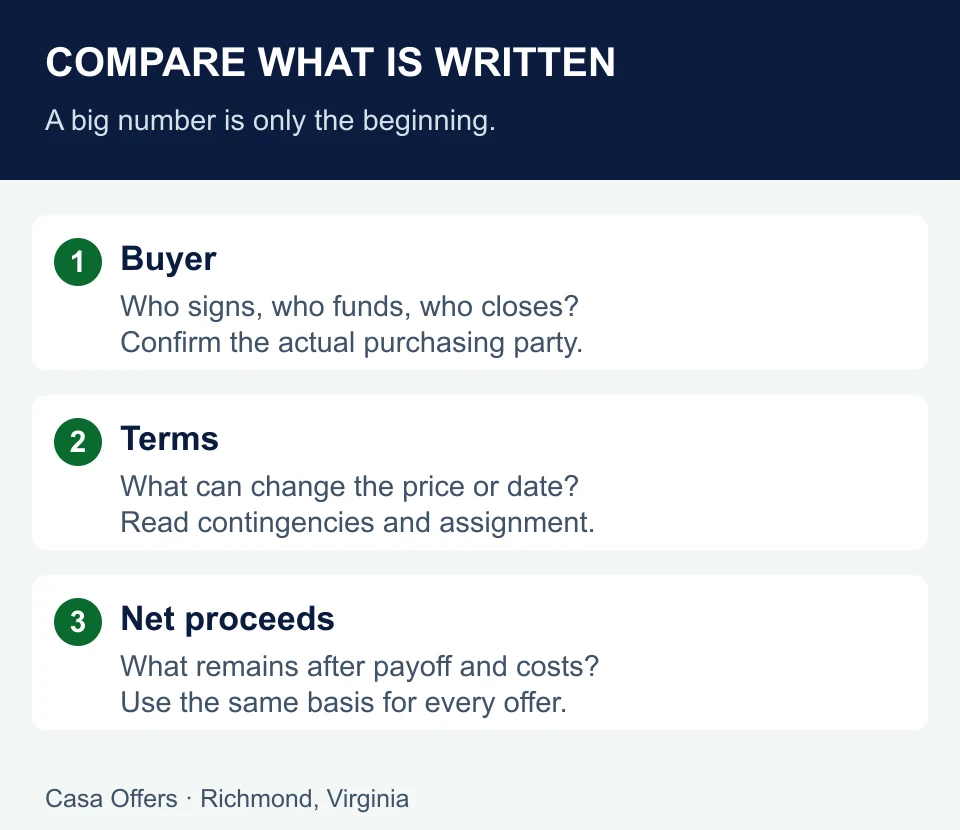
Put the written offers side by side. Use the same expected closing date and property condition, then account for everything that comes out of the price.
Keep two figures separate. Estimated cash at settlement = purchase price − mortgage and other required payoffs − seller-paid charges and credits on the settlement estimate. That is the estimated money you receive from closing.
For the economic comparison between sale options, also subtract preparation, cleanout and net holding costs you pay separately. That result helps you compare the overall outcome before your personal sale-tax consequences. Do not deduct an expense twice because it already appears in the settlement estimate.
Here is how Casa’s cost policy works: we cover the selling and closing costs described in our agreement. There is no agent commission, title fee or research fee charged to you, and we do not ask you for a seller concession. What you already owe is separate: your mortgage, past-due property taxes, liens or fines still have to be addressed.
For illustration, if our written offer is $100,000 and there are no existing debts or other required payoffs, that means $100,000 to you at settlement under those terms. If there is a mortgage or another obligation, it comes out of the proceeds. This describes cash at settlement; your personal sale-tax consequences are a separate question.
Ask the closing professional for a seller estimate showing who pays every charge. Put it beside the written offer. With any buyer, “no commission” is only one part of the comparison; the other deductions matter too.
Use a dated mortgage payoff. The Consumer Financial Protection Bureau explains that a payoff can differ from the balance on your statement because it includes interest through the intended payoff date and may include unpaid fees.
Include the cost of another month if one offer closes later: interest, insurance, utilities, maintenance and other bills you will actually pay. For a rental, account for rent you reasonably expect to collect. Keep principal payments consistent with the updated payoff so you do not count them twice.
Use your house’s numbers, written down on the same basis. Mark unknown charges as pending and ask the closing professional to confirm them before you rely on the estimate.
5. Confirm who holds the deposit and handles closing
Casa’s earnest-money deposit typically starts at $1,000 and is provided promptly to the title company handling the closing. The agreement should specify the amount, due date, holder and return conditions. Ask for confirmation that the deposit arrived rather than relying on a promise that it is on the way.
For every offer, identify the actual closing company and verify its registration and any licensing, bonding or insurance claims. Read what the agreement says if either party fails to perform.
A deposit can show commitment, but its protection depends on the contract and how it is handled. A large deposit with broad refund rights is different from money that remains at risk after specific conditions expire. Do not assume every missed deadline automatically gives you the deposit.
Identify the closing professional early. Virginia law specifies who may act as a settlement agent and requires agents subject to the chapter to register with the appropriate licensing authority. Ask how to independently verify the professional handling your transaction.
Confirm who is reviewing ownership, obtaining payoffs, addressing liens and explaining the seller’s settlement figures. A buyer’s promise of a clean sale is not a substitute for finding the actual title issues and resolving them.
Protect payment instructions, too. The CFPB’s closing-scam guidance recommends keeping trusted contacts who can confirm the process and instructions. Establish the closing office’s phone number independently. Verify unexpected changes through that trusted channel before sending money or sensitive information.
6. Put “as-is” and possession into ordinary language
With Casa, take the things you want and leave the unwanted household belongings behind. You do not have to paint, clean the house, empty the refrigerator or take out the trash before handing it over. Put that cleanout arrangement into the written terms so you are not wondering about it on moving day.
That can be a meaningful part of the decision. A storage unit, moving company and separate cleanout can turn “What do I do with all this?” into another expensive project. Some Casa cleanouts have cost us $3,000–$7,000 even at our contractor rates. That is our reported experience with those properties, not a quote for every house or a separate cleanout bill to the seller under our agreed as-is purchase.
Agree on keys and possession as carefully as belongings. If you need time after closing, get any arrangement and its responsibilities in writing before you plan around it.
If tenants live there, identify the lease, rent and deposit records, access arrangements and who is responsible for the tenancy after closing. Selling does not make those details disappear. The buyer needs to agree to the actual occupancy arrangement before you promise a delivery condition.
Check the property’s jurisdiction as well. A Richmond mailing address does not necessarily put a house inside the City of Richmond. Start with the correct locality’s property record; the city assessor provides property-search access for city properties. Henrico and Chesterfield have their own records and offices.
Bring any code notice, permit question or ownership document into the discussion early. The useful buyer is the one who explains how the actual issue affects the purchase. For repair decisions, our Virginia guide to what not to fix before selling helps you avoid taking on unnecessary work before comparing an as-is offer.
7. Look for progress you can verify
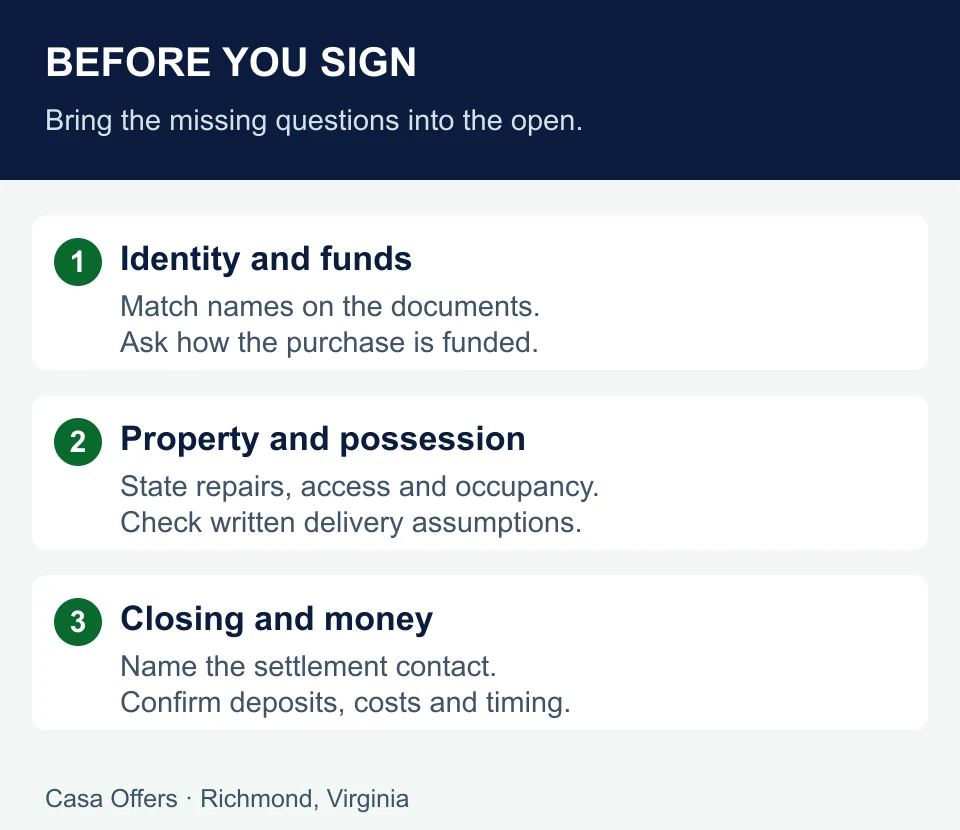
A dependable buyer turns promises into completed steps: a clear agreement, funding questions answered, deposit handled as agreed, property review finished and a closing file moving forward.
Some delays come from getting the documents needed to close: a bank’s mortgage payoff, unresolved ownership after a death or matters arising from a divorce. Raise those issues early. The buyer and closing professional should explain what is missing, who is obtaining it and how it affects the date.
Ask who will update you and when. If a deadline passes, get the explanation and next commitment in writing. Repeated extensions without concrete progress deserve a fresh look at the deal.
Before paying movers, giving up another housing option or making commitments that are hard to reverse, check which conditions remain. Your family’s next step deserves more than “we should be good.”
A higher price is worth pursuing when the terms and buyer support it. The goal is a buyer you can reasonably expect to complete the transaction, at a price and on terms that work for you.
Compare companies that buy houses in Richmond, VA
Use this checklist with every offer, including Casa Offers. Leave unanswered items visible instead of filling them in with optimistic assumptions.
| Check | Get this answer | Where to confirm it |
|---|---|---|
| Buyer | Legal name, signer and any assignment plan | Agreement and identity records |
| Funds | Source and remaining approvals | Current evidence and independent verification |
| Conditions | Review, cancellation and extension rights | Contract and written deadlines |
| Net proceeds | Your costs, payoffs and estimated cash | Dated seller estimate |
| Deposit | Amount, holder, due date and refund terms | Agreement and receipt |
| Handoff | Belongings, tenants, keys and possession | Written occupancy and property terms |
| Follow-through | What is complete and what remains | Buyer and closing-office updates |
You can request Casa’s offer as one side of that comparison. Describe the condition, occupancy and timing honestly so the conversation starts with the house you actually have.
Questions Richmond sellers ask about cash buyers
Should I automatically accept the highest offer?
Compare its estimated net proceeds, conditions and likelihood of completion. A higher price with unresolved funding or broad cancellation rights deserves more investigation. A lower price is not automatically a better deal either.
Is an assignment the same thing as a scam?
No. Find out what is proposed, what the contract permits and who remains responsible. If you want the named buyer to purchase directly, discuss that before signing and have your attorney review the terms.
Can I compare a cash sale with listing the house?
Yes. If you have time, money for preparation and a house that is ready for the market, listing may be the better fit. We do not want you to choose Casa merely because you did not compare the alternatives. Ask a local agent about an as-is listing, too; preparing a house perfectly is not the only way a listed sale can work.
People usually come to us out of necessity or convenience: work they cannot take on, a move they need to make, or the choice to avoid managing a sale and cleanout themselves. Compare what each route leaves you, what you must do and how much uncertainty you can carry.
Get the number, then check what stands behind it
You are selling a house so you can do something else with your life. The conversation with Casa is free and the offer carries no obligation to sell. We can explain the process before you decide whether it fits. A signed purchase agreement is a different step: understand its commitments before you accept.
Not every house is right for us, and we are not right for every homeowner. If we can help, we help. If another route makes more sense, the conversation can still help you find your next step. Our business earns a profit by taking on the purchase and work ahead; helping an owner move on and returning a cared-for home to the neighborhood are part of why we do it.
For more about the local service, see selling a Richmond house to Casa Offers. Or start with your address and request an offer to compare. Ask us the same seven questions.