
2026-11-27T19:43:01-07:000000000130202611
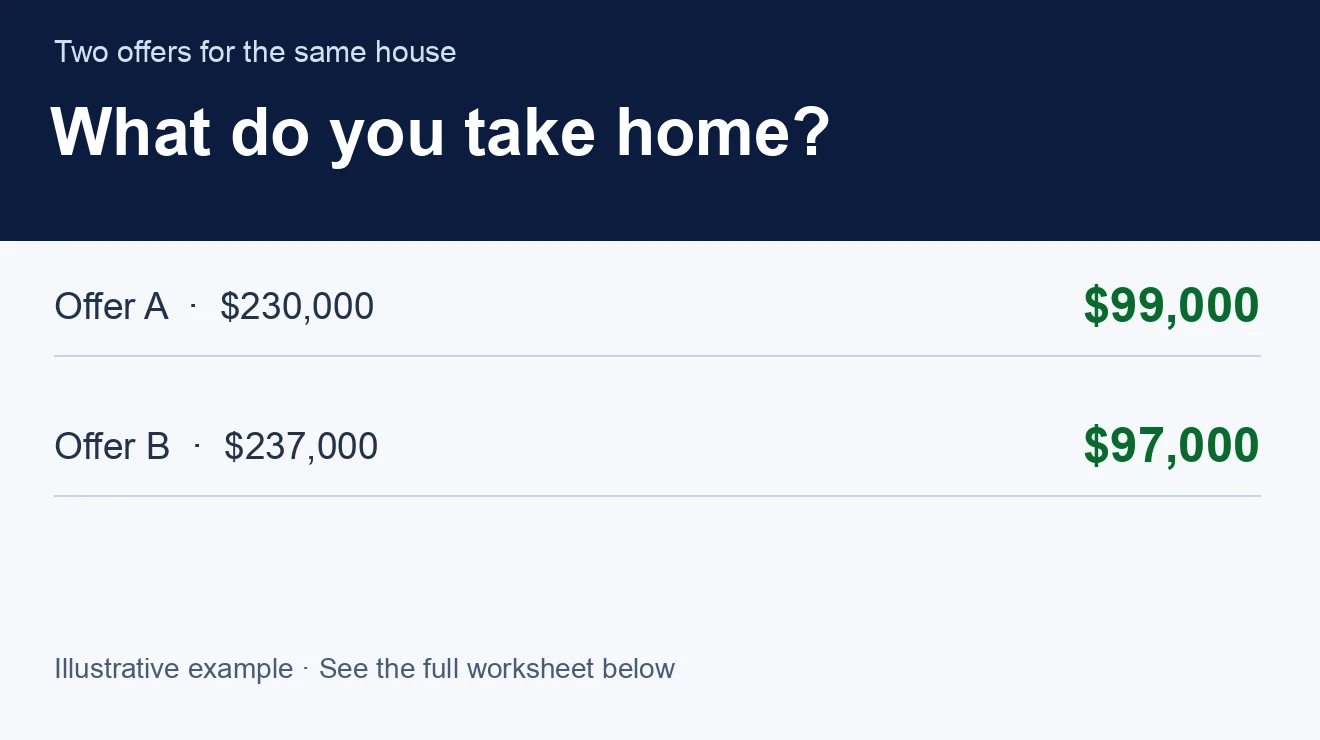
In this example, the $237,000 offer leaves you $2,000 worse off than the $230,000 offer. When someone asks me, “Should I take this cash offer for my house?” I put the two offers side by side. Watch what happens when one buyer asks for a credit and leaves you with the bills.
See how we buy in Virginia and Connecticut. If your home is elsewhere, ask us to check the address.
How do I compare a cash offer for my house with another one?
Imagine selling the house in its current condition. Buyer A agrees to cover the negotiated closing expenses. You expect to spend $1,000 clearing out part of the house before handing it over. Buyer B offers more but asks for a $6,000 credit and leaves $4,000 in expenses to you. Both sales close on the same day with a $130,000 mortgage payoff.
| Item | Offer A | Offer B |
|---|---|---|
| Contract price | $230,000 | $237,000 |
| Buyer credit | $0 | −$6,000 |
| Your closing expenses | $0 | −$4,000 |
| Mortgage payoff | −$130,000 | −$130,000 |
| Received at closing | $100,000 | $97,000 |
| Cleanout paid separately | −$1,000 | $0 |
| Money you keep | $99,000 | $97,000 |
In this illustration, the $7,000 advantage disappears and takes another $2,000 with it. Change just one term and the answer changes. If B drops the $6,000 credit, you keep $103,000 with B. You now know exactly what to ask that buyer to change.
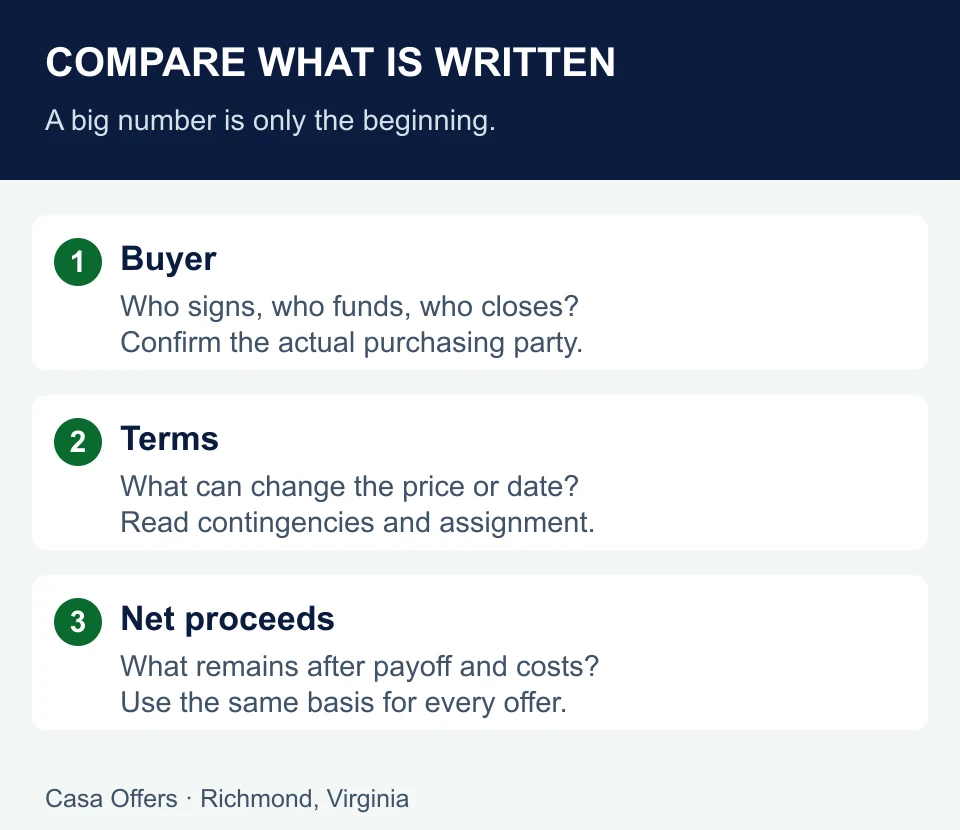
Request an estimated settlement statement. Check off amounts supported by the contract and mark any deduction that still depends on an invoice. When comparing a cash offer with another route, a missing bill can matter as much as the headline price.
Ask for an itemized estimate of what you keep
| Purchase price | $117,250 |
|---|---|
| Two debts paid at closing | −$101,950 |
| Seller’s share of property taxes | −$350 |
| Amount due to the seller | $14,950 |
Figures rounded to the nearest $50. About $500 for the settlement service and a $50 fee for wiring the seller’s proceeds appeared on the buyer’s side of the final statement. Subtracting them from the seller again would count them twice.
Write down the purchase price, then list three groups of deductions: expenses you agree to pay to sell, existing debts to settle at closing, and money you will spend out of pocket before handing over the keys. Write two totals underneath. One is the money you expect at closing. The other is what you keep after expenses you paid yourself. A moving bill you paid a week before closing will seldom be sitting on the settlement statement.
“Which of these bills will I actually have to pay?” Ask about each blank line. “We pay closing costs” still leaves room for a cleanout bill, a commission under a listing agreement you already signed, or a credit the buyer wants. Get the answers in writing. Our guide to how a cash buyer prices a house explains the other side of the calculation using a Richmond example.
For a Connecticut home, you can also compare what two listing proposals leave after fees and prep work.
Get a payoff for the day you plan to close
Your mortgage app can give you a starting number. Ask the servicer for the amount it takes to pay the loan off on the proposed closing date. It may include interest through that day and outstanding fees. Ask whether it needs updating if the date changes. The CFPB explains the difference between a balance and a payoff.
Here’s how I explain it at Casa. If we agree on $100,000, cover the agreed expenses and you owe nothing, you should be able to point to $100,000 on your settlement statement. If you owe back taxes or have a second mortgage, get the amounts while you still have time to compare.
What will one more month cost you?
If one buyer needs you to finish the kitchen, get a written scope, a price and a realistic timeline. Carrying two places for another month can mean extra interest, utilities and insurance. Separate mortgage principal from those expenses so that you do not deduct it again after updating your payoff.
If a buyer wants the house empty, tell them what is actually inside. Getting a heavy sofa down a narrow staircase costs money even when the sofa has no resale value. If you already have an agent, include them in the comparison and check your signed listing agreement.
Ask one last question before accepting
“If we close on the agreed date and the house is as described, how much will I receive, what do I pay separately, and what could still change?” Keep the written answer beside the offer. If a number depends on an inspection, ask when that decision becomes final. If you can afford to list and wait, take the same worksheet to an agent and compare that route. You can also ask Casa whether we evaluate your address before making a commitment.
What if a buyer advances moving money before closing?
When we agree to advance moving money, the advance comes out of the agreed purchase price. Add what you received early to what you will receive at closing before comparing two offers. Ask to see both amounts in writing.
If the offers leave you about the same, I would look at what each one asks you to do before you can move. Here’s how to check when the money will actually be available.