
2026-11-22T08:58:03-07:000000000330202611
Selling a house as is in Virginia means offering it in its current condition, with repair responsibilities governed by the contract.
It does not automatically eliminate inspections, financing conditions, required disclosures or an existing mortgage. The useful question is what you must do, spend and deliver under the particular offer.
If the roof, air conditioning or cleanout is more than you can take on, you do not need to renovate the entire house before exploring a sale. You need a buyer whose plan fits the condition today and terms that do not quietly put the work back on you.
1. Selling a house as is: separate condition from contingencies
The house does not have to be fixed before someone helps you
I remember an older Richmond-area homeowner who was in her second summer without air conditioning. There was one fan in a house that felt unbearably hot. She did not have the money to do the work she had been told the house needed before it could be sold. She had equity, but that was not solving the problem she was living with each day.
Before we bought the house, I contacted a local organization that helped seniors access air-conditioning assistance. She qualified, and we helped arrange that support while the purchase moved toward closing. Casa then closed and bought her house.
The practical problem mattered before the closing date. She needed a way out, and she also needed help while she was still there. If the house feels like too much to take on, tell us what is happening. You do not have to make it presentable before having that conversation. Assistance programs have their own eligibility rules; this story is one seller’s experience, not a promise of the same support for every property.
An as-is listing communicates that you are not offering a renovated house. The contract determines what happens next. An inspection may still be allowed. A buyer may still have a termination right, a financing condition or a request you can accept or decline according to the agreement.
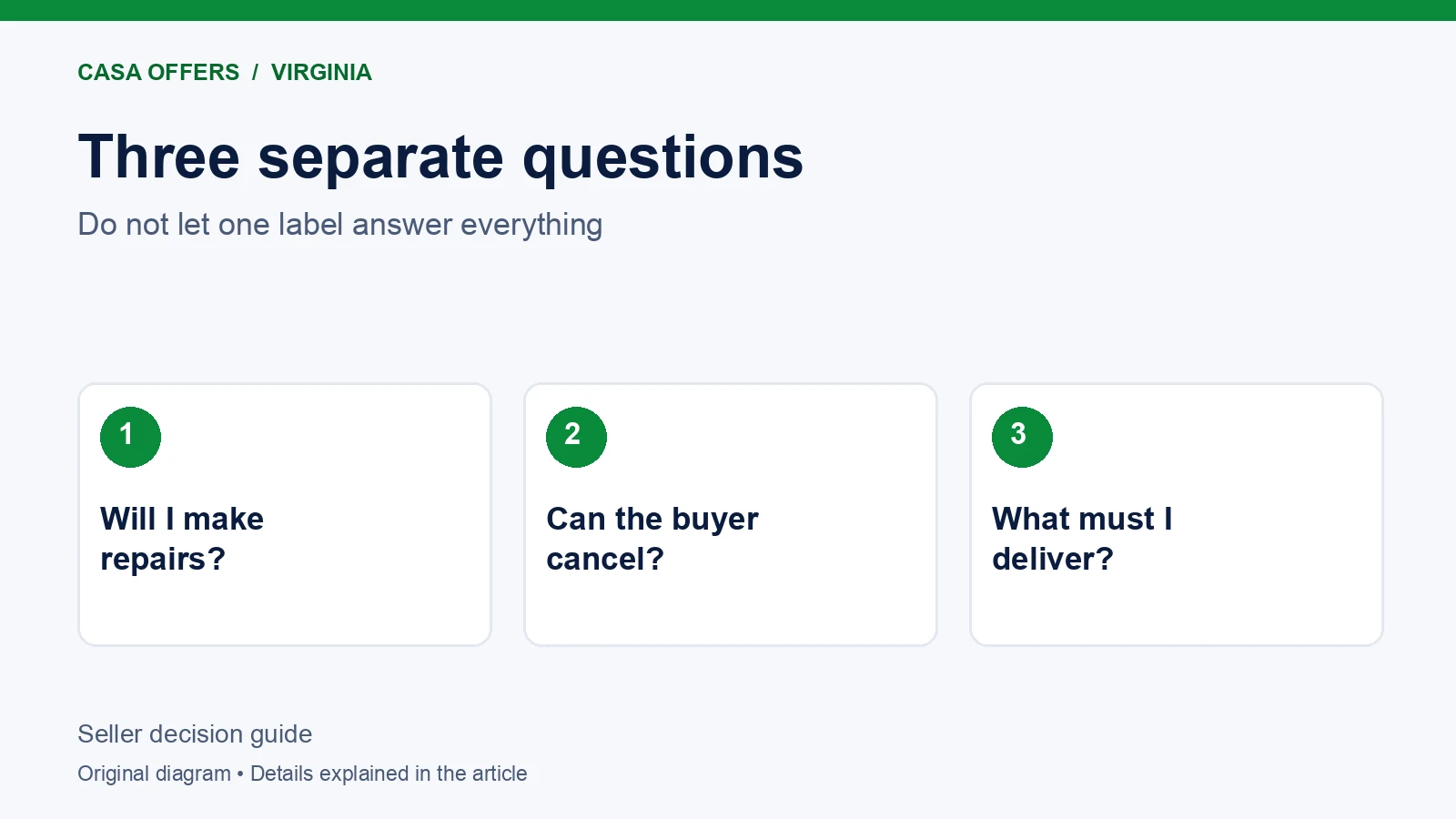
These are separate questions: Will you make repairs? Can the buyer inspect? Can the buyer cancel? Does a lender need the property to meet a condition standard? When is the price final? Ask each one before signing instead of assuming two words answer all five.
| Question | What determines the answer |
|---|---|
| Must the seller renovate? | The agreed repair obligations and other applicable requirements |
| Can the buyer inspect or terminate? | The inspection terms, deadlines and remedies in the contract |
| Will financing work? | The buyer’s funding and any lender requirements |
| Can furniture or debris stay? | A separate written agreement about belongings and delivery |
| What will the seller receive? | Price, cost allocation, existing obligations and settlement figures |
2. Choose a buyer who can buy the condition you have
A homeowner planning to live in the property, an investor renovating for resale and a landlord may evaluate the same house differently. The condition that works for one buyer’s financing or budget may not work for another. Ask how the buyer will fund the purchase and whether repairs are a condition of that funding.
You can market the house as-is through an agent, sell it yourself or consider a direct buyer. A listing offers exposure; it still needs a workable price and a buyer who accepts the terms. A direct offer can avoid repeated showings and preparation, but you should compare what you receive and what responsibilities transfer.
At Casa Offers, we evaluate houses in their current condition. You can begin the conversation without paying to make the property market-ready. That is especially useful when spending money to find out whether you can sell is the problem you are trying to solve.
3. Set the price around condition and the buyer’s actual work
Selling a house as is does not mean accepting any number someone offers. It means pricing the property with the work and uncertainty honestly accounted for. Separate visible cosmetic work from expensive systems, water problems, structural questions and unfinished projects that need investigation.
Ask an investor to explain the main assumptions behind the price: comparable completed sales, repair scope, carrying costs and the buyer’s return. You do not need to agree with every assumption. You do need enough detail to compare the offer with your alternative.
For a Richmond-area property, use the right jurisdiction’s records. Richmond city, Henrico and Chesterfield are different localities, even when mailing addresses look similar. Richmond’s Online Permit Portal supports permit applications and status checks. An unfinished project or unanswered permit question belongs in the file; a buyer’s willingness to purchase does not itself resolve it.
Our guide to what not to fix before selling addresses a different decision: which preparation expenses may be worth skipping. Here, the goal is to make the sale terms match the condition you are actually delivering.
4. Keep disclosure duties separate from an as-is clause
The Virginia disclosure statute sets out a buyer-due-diligence framework, with separate disclosures applicable in particular circumstances. An as-is sale does not grant permission to misrepresent or conceal a problem. Ask a Virginia real-estate attorney what applies to this property and transaction.
Most pre-1978 homes also fall under federal lead-paint disclosure rules. The EPA’s seller guidance describes providing known-hazard information, available records and required buyer materials before the contract. A buyer’s renovation plan does not, by itself, replace those requirements.
Keep what you know separate from what you assume. Share existing reports accurately; do not describe an untested system as working or an unfinished repair as complete. If you do not know the answer, say so and let the appropriate professional investigate.
5. Put belongings, cleanout and possession in writing
“As-is” is not a complete inventory of what you can leave. Specify appliances, furniture, stored items, debris and anything another person owns. Identify hazardous materials or unusual removal needs so the buyer can evaluate them. Make sure you have the right to dispose of what stays.
At Casa, sellers can take the belongings they want and leave unwanted items for us to handle, subject to the actual property’s agreement. You should not have to rent storage for things you do not want just to make a sale possible. Confirm the arrangement rather than assuming every cash buyer offers it.
If a tenant occupies the property, a sale does not by itself promise an empty house. Existing leases, rights and any agreed move-out need their own review. If you plan to remain after closing, document possession, access, responsibilities and timing separately.
6. Compare the money left and the money needed before selling
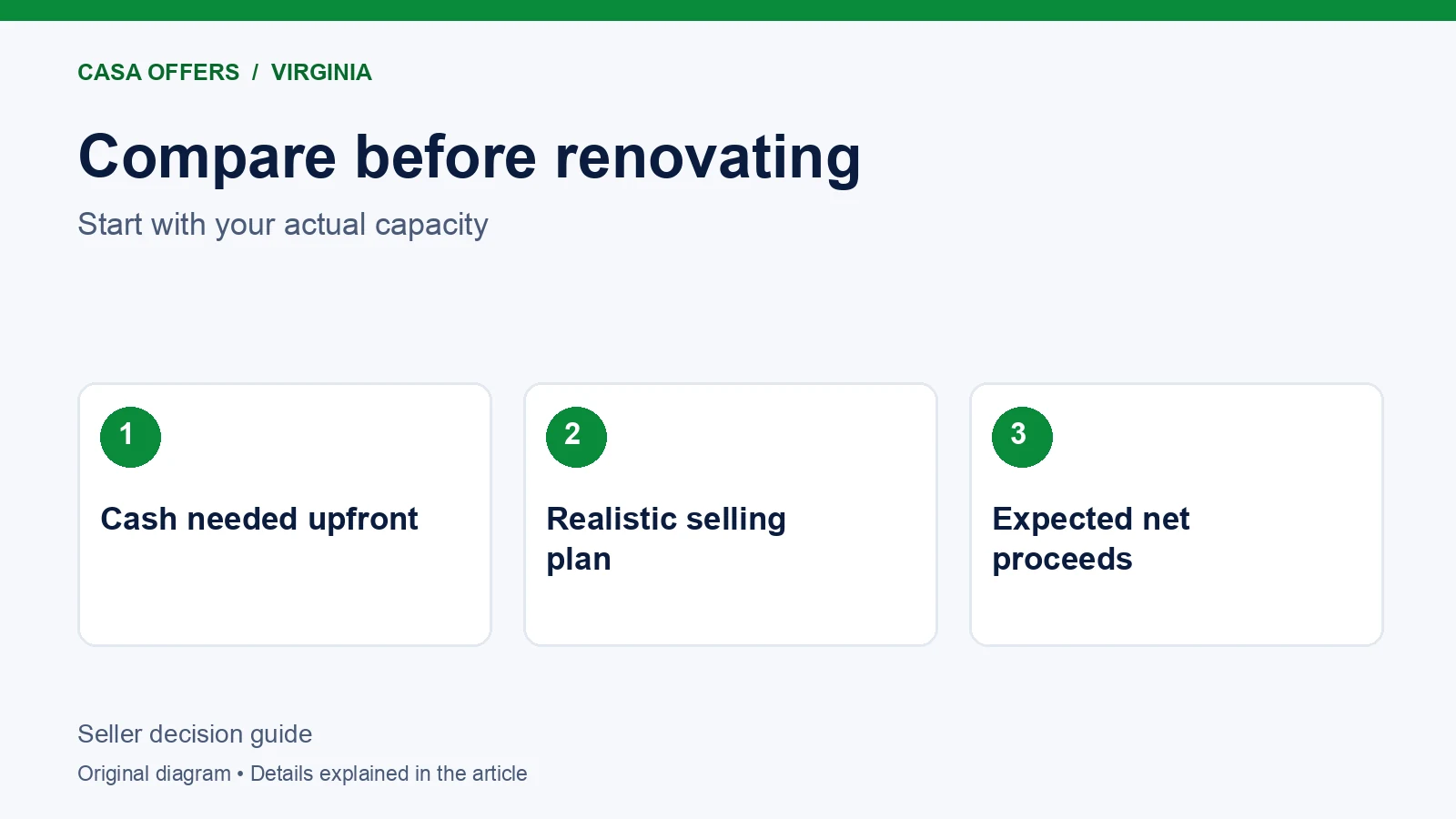
A renovation plan may look attractive on paper and still be impossible to fund. Compare both the expected proceeds and the cash you would need before getting them. Repairs, cleanout, utilities, insurance and another period of ownership can affect the choice even if they do not appear as one line on the closing statement.
| Decision | As-is route | Prepare and list |
|---|---|---|
| Upfront cash | Identify any costs the seller must still cover | Obtain real repair, preparation and carrying estimates |
| Price | Use a written offer for the current condition | Use a supported likely sale range, not an ideal asking price |
| Selling expenses | Confirm each agreed fee and charge | Include negotiated compensation, concessions and settlement expenses |
| Existing debt | Account for mortgage, taxes and liens | Account for the same obligations and any additional time |
| Uncertainty | Read inspection, funding and termination terms | Allow for preparation, marketing and the buyer’s conditions |
Our offer structure at Casa covers the agreed selling and closing expenses, while existing seller debts remain the seller’s responsibility. Have the settlement team show the proposed net. Selling a house as is does not erase a mortgage or unpaid taxes, and an investor’s offer is not automatically the best financial outcome.
7. Get an as-is offer before committing to renovation
If you have time, available money and a house that can compete well after preparation, listing may produce the result you want. If the work, funding or logistics are the barrier, a direct as-is offer gives you another concrete option. Necessity and convenience are both valid reasons to compare.
Start with the address, current condition, who owns and occupies the property, and what you want to happen next. Tell us about the issue you are worried will make the house unsellable. The first step is a free conversation and no-obligation offer, not a promise to accept it.
Have a firm deadline? Use our Richmond fast-sale guide for the separate title, payoff and moving milestones. Choosing as-is terms solves the preparation question; the closing still needs a workable plan.
Get My Written Cash-Offer Review
Questions about selling a house as is in Virginia
Can I sell as-is with a broken air conditioner or an old roof?
You can explore a sale in the current condition. Tell the buyer what you know, evaluate applicable requirements and choose terms and funding suited to the property. Do not pay for replacement solely because you assume no buyer will consider it.
Can an as-is buyer lower the price after an inspection?
The contract governs the buyer’s rights and your choices. Ask when the price becomes firm, what can change it and whether the buyer has an inspection or termination condition. A label alone does not answer that.
Do I have to empty the house?
Only the agreement can settle that. Casa can include unwanted belongings and cleanout in its purchase plan; specify what remains and when you will deliver possession.